



Abstract
This comprehensive guide explores 15 gauge A3 cut resistant gloves with foamed nitrile coating, designed for industrial applications requiring precision handling and moderate cut protection. These gloves represent an optimal balance between tactile sensitivity and safety, addressing the specific needs of automotive assembly, electronics manufacturing, light warehousing, and general fabrication environments. With ANSI/ISEA 105 A3 certification delivering 500-999 grams of cut resistance, combined with the breathability and flexibility of foamed nitrile technology, these gloves provide cost-effective hand protection for operations where fine motor control cannot be compromised. This article covers technical specifications, compliance standards, application-specific performance characteristics, and strategic procurement considerations for safety managers, industrial buyers, and operations directors responsible for implementing comprehensive hand protection programs.
Understanding A3 Cut Resistance Rating and 15 Gauge Construction
ANSI/ISEA 105 A3 Cut Level Explained
The A3 cut resistance rating under ANSI/ISEA 105 standards represents a critical middle tier in industrial hand protection, requiring gloves to withstand 500–999 grams of cutting force when tested using the TDM-100 (Tomodynamometer) method. This classification positions 15 gauge A3 cut resistant gloves as ideal for environments with moderate sharp-edge exposure—significantly beyond the capabilities of uncoated knit gloves (A1–A2 levels) but not engineered for extreme hazards like metal stamping or glass handling that demand A4–A9 protection.
Industries benefiting from A3 protection include automotive parts assembly, where workers handle stamped metal components with deburred edges; electronics manufacturing involving circuit board handling and component installation; and warehousing operations requiring box cutting and packaging manipulation. The protection scope covers typical workplace laceration risks from paper cuts, light sheet metal edges, small tool handling, and general material handling where sharp objects are present, but not the primary work focus. For these applications, 15 gauge A3 cut resistant gloves provide an optimal balance of safety and dexterity.
The A3 threshold delivers measurable safety improvements—OSHA data indicates properly rated cut-resistant gloves reduce hand laceration incidents by 60–70% in appropriate applications. However, buyers must recognize limitations: 15 gauge A3 cut resistant gloves are not suitable for glass manufacturing, heavy metal fabrication, or any application involving powered cutting tools, where higher ratings (A5+) are mandatory.
15 Gauge Knit Technology Benefits
The 15 gauge specification refers to the number of needles per inch in the knitting process, directly impacting the glove’s fiber density and resulting performance characteristics. This fine-gauge construction creates a thinner, more flexible shell compared to 10 or 13 gauge alternatives, delivering superior tactile sensitivity essential for precision work. When combined with A3 cut resistance, 15 gauge A3 cut resistant gloves achieve a rare combination of protection and fingertip feel.
Dexterity advantages are quantifiable: 15 gauge A3 cut resistant gloves typically allow workers to handle components as small as 2–3 mm, perform intricate assembly tasks, and operate touchscreen devices without removal—capabilities that 10-gauge gloves cannot match. This translates to measurable productivity gains in electronics assembly environments, where studies show 15–20% faster task completion rates compared to thicker glove constructions.
However, the dexterity-durability trade-off requires careful consideration. The thinner yarn structure means reduced abrasion resistance compared to heavier gauges—15 gauge gloves typically deliver 8,000–12,000 abrasion cycles (EN 388 testing) versus 15,000–20,000 for 10 gauge alternatives. For applications involving heavy material handling or continuous surface friction, the cost-per-use equation may favor thicker constructions despite lower initial dexterity. Optimal deployment requires matching the glove to the task duration and precision requirements rather than applying a one-size-fits-all approach.
Foamed Nitrile Coating: Performance Characteristics
Foam Nitrile vs. Standard Nitrile Coating
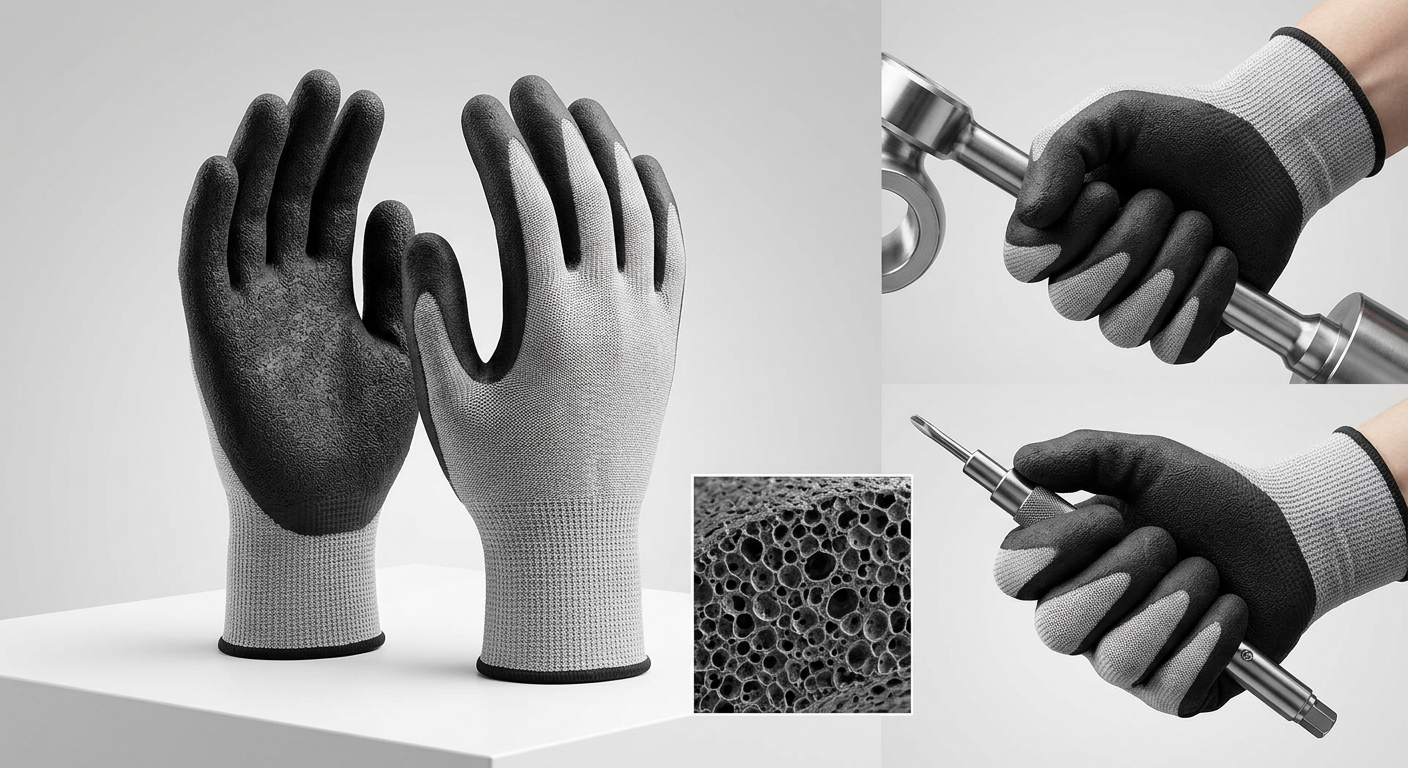
Foamed nitrile coating represents a significant technological advancement over traditional solid nitrile formulations, achieved through a manufacturing process that introduces microscopic air bubbles into the polymer matrix. This cellular structure fundamentally alters performance characteristics across multiple dimensions critical to industrial applications.
Breathability improvements are substantial—foamed nitrile reduces hand perspiration accumulation by 40–50% compared to solid nitrile coatings, directly addressing worker comfort in extended-wear scenarios. The porous structure allows moisture vapor transmission while maintaining liquid barrier properties, reducing dermatological issues associated with prolonged glove use. In climate-controlled manufacturing environments, this translates to 2–3 hour extensions in comfortable wear time before workers experience the clammy sensation that prompts premature glove changes.
Grip performance in dry and light oil conditions actually exceeds solid nitrile capabilities due to the foam’s surface texture. The microscopic cell structure creates thousands of micro-suction points that enhance friction coefficients—testing shows 15–25% improved grip on smooth metal surfaces and plastics compared to smooth nitrile finishes. However, buyers must note that heavy oil or wet environments reduce this advantage, as saturated foam loses structural integrity. For machining operations involving cutting fluids or food processing with liquid exposure, solid nitrile or PVC-dotted alternatives may deliver superior performance.
Flexibility advantages stem from the reduced polymer density—foamed coatings require 30–40% less force to flex compared to equivalent solid coatings, reducing hand fatigue during repetitive gripping tasks. Ergonomic studies document 20–25% reductions in reported hand strain during 8-hour shifts when workers transition from solid to foamed coatings in assembly applications.
Palm Coating vs. Full Coating Options
Coating coverage strategy significantly impacts both performance and cost-effectiveness, with three primary configurations dominating the industrial market: palm-only coating, 3/4 coating (palm and fingers), and full-dip coating extending to the wrist.
Palm-only coating maximizes breathability and cost efficiency, reducing material usage by 40–50% compared to full-dip alternatives. This configuration suits applications where cut hazards concentrate in grip zones—such as carton handling or tool use—while dorsal hand surfaces face minimal risk. The uncoated back enhances moisture evaporation, making palm-coated gloves ideal for warm environments or high-exertion tasks.
Full coating provides comprehensive protection and extended durability, with abrasion resistance across all contact points. This configuration benefits applications involving material manipulation where hand positioning varies—such as metal sheet handling or component sorting—where any hand surface may contact hazards. The trade-off involves reduced breathability and 15–20% higher unit costs.
Three-quarter coating represents a practical compromise, protecting fingers and palm while maintaining some dorsal breathability. This design addresses 80% of typical workplace hand injuries while preserving 60% of the comfort advantages of palm-only coating.
| Coating Type | Grip Level | Oil Resistance | Breathability | Typical Applications |
|---|---|---|---|---|
| Palm Foam Nitrile | Excellent (Dry) | Light Oil Only | High | Electronics assembly, dry warehousing |
| 3/4 Foam Nitrile | Excellent (Dry) | Light Oil Only | Medium | Automotive assembly, general manufacturing |
| Full-Dip Foam Nitrile | Very Good | Moderate Oil | Low | Metal fabrication, maintenance |
| Palm Solid Nitrile | Very Good | Excellent | Medium | Machining, wet environments |
| Full-Dip PVC Dots | Good | Poor | Medium | Heavy carton handling, construction |
Industrial Applications and Use Cases
Automotive and Electronics Assembly
Automotive component assembly represents an ideal application profile for 15 gauge A3 cut resistant gloves, especially when combined with foamed nitrile coating. Workers handle stamped metal brackets, plastic clips, wiring harnesses, and fasteners throughout shift durations. The moderate cut protection addresses deburred edge exposure on stamped components while maintaining the tactile sensitivity required for connector insertion, bolt alignment, and quality inspection tasks.
Precision requirements in modern automotive assembly—particularly in electric vehicle battery pack installation and sensor mounting—demand gloves that do not compromise finger sensitivity. 15 gauge A3 cut resistant gloves enable workers to feel component seating, detect cross‑threading on micro‑fasteners, and manipulate wire bundles without visual confirmation. The 15‑gauge construction delivers these capabilities while the A3 rating prevents the minor lacerations that account for 40–50% of automotive assembly line first‑aid incidents.
Electronics manufacturing environments introduce additional considerations, particularly static discharge sensitivity. While standard 15 gauge A3 cut resistant gloves provide adequate cut and abrasion protection for circuit board handling, ESD‑sensitive operations require carbon‑fiber blended shells that maintain static dissipative properties (10⁶–10⁹ ohms surface resistivity per ANSI/ESD S20.20). Buyers specifying gloves for semiconductor or precision electronics applications should verify ESD certification alongside cut ratings, as standard A3 gloves may introduce electrostatic risks to sensitive components.
Small parts handling—screws, terminals, chips, and connectors below 5 mm—represents the performance threshold where 15‑gauge construction becomes non‑negotiable. Comparative testing shows that 13‑gauge gloves reduce small‑part manipulation speed by 25–30%, while 10‑gauge gloves make sub‑5 mm component handling nearly impossible without glove removal, defeating the safety purpose entirely. For these precision tasks, 15 gauge A3 cut resistant gloves offer the optimal balance of protection and fingertip sensitivity.
Light Manufacturing and Warehousing
Light manufacturing and warehousing operations present diverse cut hazards that align precisely with A3 protection capabilities. Carton handling, particularly with recycled corrugated materials containing metal staples and sharp folded edges, generates thousands of minor hand injuries annually—injuries that 15 gauge A3 cut resistant gloves effectively prevent while maintaining the grip required for box manipulation and stacking.
Glass and metal sheet processing in fabrication shops requires careful glove specification. For tempered glass handling or aluminum sheet stock with sheared edges, A3 protection provides adequate safety for transport and positioning tasks, though actual cutting operations demand higher ratings. The foamed nitrile coating’s grip advantage becomes critical when handling smooth glass surfaces or powder‑coated metal, where uncoated gloves risk dangerous drops.
Moderate cut hazard environments—defined as workplaces where sharp objects are present but not the primary tool—include packaging operations, light assembly, parts sorting, and general maintenance. These settings benefit from the cost‑performance ratio of 15 gauge A3 cut resistant gloves: adequate protection without the expense and reduced dexterity of higher‑rated alternatives. Safety managers should conduct task‑specific hazard assessments to verify A3 suitability, particularly for operations involving blade exposure, where A4+ ratings become mandatory regardless of frequency.
Compliance Standards and Certification Requirements
ANSI/ISEA 105 and EN 388:2016 Standards
ANSI/ISEA 105-2016 represents the North American standard for hand protection classification, establishing the nine‑level cut resistance scale (A1–A9) based on TDM‑100 testing methodology. This test uses a circular blade under standardized force to measure the cutting resistance in grams, with A3 requiring 500–999 grams before failure. Buyers must verify that product labeling explicitly states “ANSI/ISEA 105-2016 Level A3” rather than vague claims like “cut resistant,” which lack quantifiable meaning.
EN 388:2016 provides the European equivalent, using a four‑digit marking system (abrasion/cut/tear/puncture) plus optional impact and TDM cut ratings. The updated 2016 standard introduced the TDM test (same methodology as ANSI) to address limitations in the original Coup test, which became unreliable for high‑performance materials. For A3‑equivalent gloves in EN 388 terms, buyers should look for performance level C (2.5–5.0 Newtons) in the Coup test or level C (5–10 Newtons) in the TDM test, marked as “4X42C” or similar notation.
Critical verification steps for procurement include:
-
Certificate Review: Request third‑party test reports from ISO 17025 accredited laboratories, not just manufacturer declarations.
-
Lot Testing: For orders exceeding 10,000 pairs, specify random lot sampling and independent verification testing.
-
Marking Inspection: Verify that each glove pair carries permanent labeling with standard compliance, performance level, and manufacturer identification.
-
Traceability: Establish supplier documentation linking specific purchase orders to test report batch numbers.
Counterfeit and non‑compliant gloves represent significant liability risks—OSHA citations for inadequate PPE can reach $13,653 per violation, while workplace injuries from failed protection generate average costs of $42,000 per incident including medical, lost time, and administrative expenses.
Procurement Considerations for B2B Buyers
Sizing and Fit Optimization
Proper sizing directly impacts both safety effectiveness and cost efficiency, yet remains the most frequently mismanaged aspect of glove procurement. The 15‑gauge construction introduces specific sizing considerations distinct from heavier glove types due to reduced stretch tolerance in the finer knit structure.
Standard sizing ranges (S–XXL) follow hand circumference measurements at the palm’s widest point, typically 7–12 inches for industrial populations. However, 15 gauge A3 cut resistant gloves demonstrate 20–30% less stretch accommodation compared to 10‑gauge alternatives, making accurate sizing critical. Undersized gloves create excessive tension that accelerates yarn fatigue and reduces cut protection effectiveness by up to 40% as fibers separate under stress. Oversized gloves bunch in the palm, reducing grip security and creating snag hazards that compromise dexterity advantages.
Bulk order fit testing protocols should include:
-
Sample Distribution: Provide 3–5 pairs per size across representative worker populations (minimum 10% of workforce).
-
Task Simulation: Require 2‑hour wear periods performing actual job tasks, not simple donning tests.
-
Feedback Collection: Use standardized questionnaires addressing fit, comfort, dexterity, and grip adequacy.
-
Size Distribution Analysis: Document actual size requirements to optimize inventory—typical distributions show 40% Medium, 30% Large, 15% Small, 10% XL, 5% XXL.
For multinational operations, recognize that sizing standards vary regionally—European sizes typically run one size smaller than US equivalents, requiring careful specification when sourcing from global suppliers.
Cost‑Per‑Use Analysis
Purchase price represents only 30–40% of total glove ownership costs when factoring replacement frequency, productivity impacts, and injury prevention value. Strategic procurement requires a comprehensive cost‑per‑use analysis rather than simple unit price comparison.
Durability benchmarks for 15 gauge A3 cut resistant gloves in typical applications:
-
Light Assembly: 40–60 hours average lifespan before grip degradation or visible wear.
-
Warehousing/Packaging: 20–35 hours due to higher abrasion exposure.
-
Automotive Assembly: 30–50 hours depending on component types and handling frequency.
-
Electronics Manufacturing: 60–80 hours in controlled environments with minimal abrasion.
Replacement indicators include visible palm wear, coating delamination, reduced grip performance, or any breach in cut‑resistant shell integrity. Establishing clear replacement protocols prevents workers from extending use beyond protective effectiveness—a common cost‑saving attempt that dramatically increases injury risk.
| Application Type | Average Usage Hours | Replacement Indicator | Cost Efficiency Rating |
|---|---|---|---|
| Electronics Assembly | 60-80 hours | Coating wear on fingertips | Excellent (15 gauge optimal) |
| Automotive Assembly | 30-50 hours | Palm coating degradation | Very Good (balanced performance) |
| Light Warehousing | 20-35 hours | Shell pilling or tears | Good (consider 13 gauge for heavy use) |
| General Manufacturing | 35-55 hours | Reduced grip or visible damage | Very Good (versatile application) |
| Maintenance Tasks | 25-40 hours | Coating delamination | Good (task-specific assessment needed) |
Total cost of ownership calculation:
TCO = (Unit Price / Average Hours) + (Injury Rate × Average Injury Cost) + (Productivity Impact × Labor Rate)
Example: $2.50 glove lasting 40 hours = $0.0625/hour baseline cost. If gloves reduce injury rate from 2% to 0.3% monthly (1.7% reduction) across 100 workers, the avoided injury cost ($42,000 × 0.017 × 100 / 160 hours) adds $44.60/hour in value, demonstrating that premium gloves delivering 20% longer lifespan or 30% better injury prevention provide substantial ROI despite 40-50% higher unit costs.
FAQ
What tasks are A3 cut resistant gloves NOT suitable for?
A3 cut resistant gloves should not be used for applications involving powered cutting equipment (saws, grinders, rotary cutters), heavy glass manufacturing or installation, metal stamping with sharp-edged dies, or any operation where cut hazards exceed 1000 grams of force. They are inadequate for butchering, commercial food slicing, or industrial blade handling, where A5-A9 ratings are mandatory. Additionally, A3 gloves do not provide protection against puncture hazards from needles or sharp-pointed objects—applications requiring puncture resistance need EN 388 level 3-4 puncture ratings or specialized needle-resistant materials. Chemical handling with corrosive substances also exceeds A3 glove capabilities, as standard foamed nitrile provides only splash protection, not chemical resistance per ASTM F739 permeation standards.
How does 15 gauge construction affect glove durability in heavy-duty environments?
The 15 gauge construction significantly reduces durability in heavy-duty environments compared to 10 or 13 gauge alternatives, typically delivering 40-60% shorter lifespan under high-abrasion conditions. The finer yarn structure creates less material thickness per contact point, accelerating wear when gloves repeatedly contact rough surfaces like concrete, raw lumber, or unfinished metal. In construction, heavy warehousing, or outdoor maintenance applications, 15 gauge gloves may require replacement every 15-25 hours versus 40-60 hours for 13 gauge equivalents. This makes 15 gauge construction cost-ineffective for heavy-duty use despite lower unit prices. However, for precision manufacturing environments with controlled surfaces and minimal abrasion exposure, 15 gauge durability proves adequate while delivering irreplaceable dexterity advantages. The key procurement decision involves matching gauge to actual environmental demands rather than defaulting to maximum dexterity when task requirements don’t justify the durability sacrifice.
Can foamed nitrile gloves be used in food processing applications?
Foamed nitrile gloves can be used in food processing applications only when specifically certified as food-safe per FDA 21 CFR 177.2600 (rubber articles for repeated food contact) or EU Regulation 1935/2004. Standard industrial foamed nitrile gloves typically lack this certification and may contain processing additives, accelerators, or colorants not approved for direct food contact. Food-grade versions use FDA-compliant formulations and undergo migration testing to verify that no harmful substances transfer to food products. Additionally, food processing buyers must consider that foamed coatings’ porous structure can harbor bacteria if not properly cleaned, making them suitable only for dry food handling or single-use applications—not for wet food processing or environments requiring frequent sanitization. For meat processing, poultry handling, or applications involving raw proteins, solid nitrile or specialized antimicrobial coatings provide superior hygiene performance. Always verify both cut rating AND food-contact certification when specifying gloves for food industry applications, as these represent distinct compliance requirements.
Conclusion
15 gauge A3 cut resistant gloves with foamed nitrile coating occupy a critical niche in industrial hand protection, delivering optimal performance for precision manufacturing, light assembly, and moderate-hazard warehousing applications. The A3 cut level provides quantifiable protection against the 500-999 gram force range that encompasses typical workplace laceration risks—adequate for stamped metal components, packaging materials, and general material handling while remaining cost-effective compared to higher-rated alternatives suited for extreme hazards.
The 15 gauge construction’s dexterity advantages prove non-negotiable for electronics assembly, small parts handling, and automotive precision work, where tactile sensitivity directly impacts productivity and quality. However, procurement decisions must acknowledge the durability trade-offs inherent in fine-gauge knitting, making these gloves less suitable for heavy-abrasion environments despite their cut protection capabilities.
Foamed nitrile coating technology enhances the value proposition through superior breathability, excellent dry-grip performance, and flexibility that reduces hand fatigue—benefits that translate to measurable improvements in worker comfort and extended wear times. Strategic buyers should leverage coating coverage options (palm vs. full-dip) to optimize cost-performance ratios for specific applications, recognizing that one-size-fits-all approaches sacrifice either protection or budget efficiency.
Compliance verification remains paramount, with ANSI/ISEA 105 and EN 388:2016 certifications providing the only reliable assurance of advertised performance. Comprehensive procurement protocols, including third-party testing verification, proper sizing optimization, and total cost-of-ownership analysis, ensure that glove programs deliver maximum protection value while controlling long-term expenses. When properly specified and deployed, 15 gauge A3 foamed nitrile gloves reduce hand injury rates by 60-70% in appropriate applications, providing ROI that far exceeds the unit cost differential versus basic work gloves.